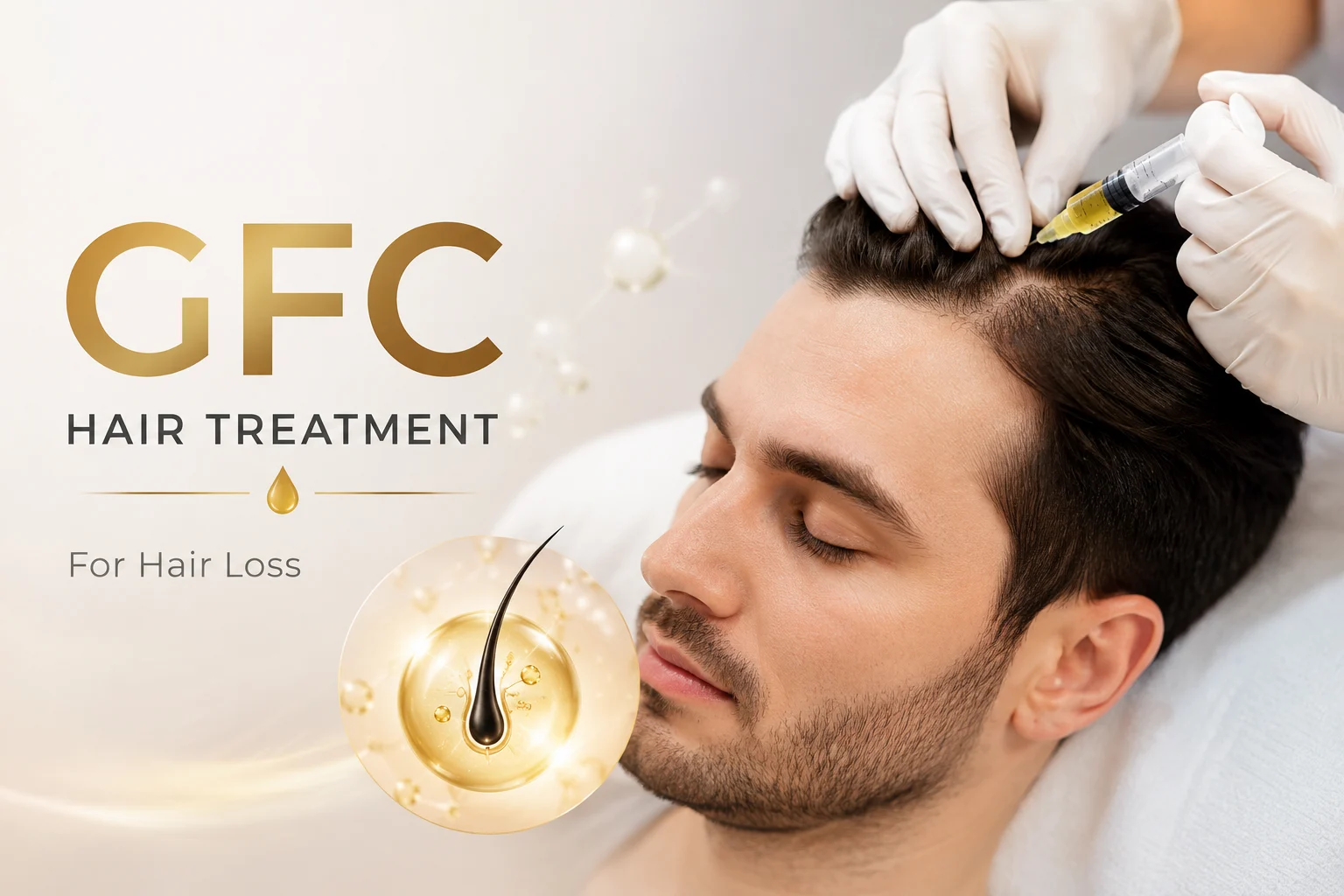
What is GFC Hair Treatment?
GFC Hair Treatment, also known as Growth Factor Concentrate Hair Therapy, is an advanced hair regrowth treatment that uses concentrated growth factors derived from a patient's own blood. The treatment is designed to support weakened hair follicles, reduce excessive hair fall, and improve overall hair density.
Unlike temporary cosmetic solutions, GFC works through the principles of regenerative medicine. The procedure utilizes naturally occurring biological signals that help stimulate follicular activity and encourage healthier hair growth cycles. This makes it a popular option for individuals seeking a non-surgical hair restoration treatment.
GFC treatment for hair loss has become increasingly popular among patients experiencing male pattern baldness, female pattern hair loss, and diffuse hair thinning. Since the treatment uses the patient's own biological material, it is generally considered safe when performed by a qualified dermatologist.
Quick Answer: GFC Hair Treatment is a dermatologist-recommended hair treatment that uses concentrated growth factors from your own blood to stimulate hair follicles, reduce hair fall, and support hair regrowth.
How Does GFC Treatment for Hair Loss Work?
Healthy hair growth depends on active hair follicles receiving adequate nutrition, blood supply, and cellular signals. When follicles become weak due to genetics, hormonal influences, stress, or aging, hair growth slows and shedding increases.
GFC therapy works by isolating powerful growth factors released from activated platelets. These biological molecules act as messengers that communicate with cells surrounding the hair follicle and encourage tissue repair and regeneration.
After preparation, the concentrated growth factor solution is delivered through targeted scalp injections into areas of thinning hair. These growth factors help improve the environment around weakened follicles and may promote stronger, thicker hair growth over time.
Read this - How to stop hair fall
What Are Growth Factors and Why Are They Important for Hair Regrowth?
Growth factors are naturally occurring proteins that regulate cell growth, tissue healing, and regeneration throughout the body. They play an essential role in maintaining healthy hair follicles and supporting continuous hair growth.
When injected into the scalp, these growth factors may stimulate cellular activity within dormant or weakened follicles. They also help improve blood circulation around the follicle, ensuring that hair roots receive adequate oxygen and nutrients.
Several studies suggest that growth factor therapy may support follicular regeneration by activating stem cells, improving vascular supply, and prolonging the anagen phase, which is the active growth stage of the hair cycle.
Which Growth Factors Are Present in GFC Hair Therapy?
One of the reasons Growth Factor Concentrate Hair Therapy is gaining popularity is because it contains multiple biologically active molecules involved in tissue repair and hair follicle stimulation.
Platelet-Derived Growth Factor (PDGF)
PDGF plays a crucial role in cellular repair and regeneration. It helps activate follicular stem cells and supports the recovery of weakened hair follicles.
Vascular Endothelial Growth Factor (VEGF)
VEGF promotes the formation of new blood vessels around hair follicles. Improved circulation ensures that follicles receive better nourishment and oxygen supply.
Epidermal Growth Factor (EGF)
EGF supports cellular proliferation and tissue regeneration. It contributes to healthier follicular activity and improved scalp health.
Insulin-Like Growth Factor (IGF-1)
IGF-1 is associated with prolonged hair growth cycles and enhanced follicular function. It may help support stronger and thicker hair growth over time.
Does GFC Regrow Hair?
One of the most common questions patients ask is whether GFC can actually regrow hair. The answer depends largely on the condition of the hair follicles being treated.
GFC treatment works best when hair follicles are still alive but weakened. In such cases, the growth factors may reactivate follicular activity and improve the production of thicker, healthier hair strands.
However, if a follicle has been permanently destroyed due to advanced baldness, scarring, or long-standing hair loss, regenerative treatments are unlikely to create entirely new follicles. This is why early intervention often produces better results.
Quick Answer: Yes, GFC may help stimulate hair regrowth in areas where hair follicles remain active but weakened. Results are generally better in early-stage hair loss than in advanced baldness.
Who Is an Ideal Candidate for GFC Hair Treatment?
GFC is commonly recommended for individuals experiencing progressive hair thinning or excessive hair shedding. It is particularly useful for patients seeking a non-surgical approach to hair restoration.
Patients with androgenetic alopecia, commonly known as male pattern baldness or female pattern hair loss, are among the most suitable candidates. These individuals often have miniaturized follicles that may respond to regenerative stimulation.
GFC may also benefit patients experiencing diffuse thinning, stress-related hair loss, postpartum shedding, or hair density reduction following illness. A detailed evaluation by a dermatologist is necessary to determine suitability.
Can GFC Help Male Pattern Baldness?
Male pattern baldness is the most common form of hair loss in men and is strongly influenced by genetics and hormones. Over time, hair follicles gradually shrink and produce thinner hair strands.
Growth Factor Concentrate Hair Therapy aims to support these miniaturized follicles by delivering regenerative growth factors directly to the scalp. This may help slow progression and improve hair density in selected patients.
The best outcomes are typically observed in individuals with early-to-moderate androgenetic alopecia, where viable follicles are still present and capable of responding to treatment.
Can Women Undergo GFC Hair Treatment?
Female pattern hair loss often presents differently from male pattern baldness. Women typically experience diffuse thinning, widening of the hair partition, and reduced hair volume.
GFC therapy may help improve follicular health and support hair strengthening in women experiencing early-stage thinning. Because it is a minimally invasive treatment, it is increasingly chosen by women seeking alternatives to surgery.
A dermatologist should always investigate underlying causes such as iron deficiency, thyroid dysfunction, hormonal imbalance, or nutritional deficiencies before initiating treatment.
Is GFC Better Than PRP Therapy?
GFC and PRP Therapy are both regenerative treatments derived from the patient's own blood. However, there are important differences in their preparation and composition.
PRP Therapy contains a concentration of platelets suspended within plasma. In contrast, GFC focuses on isolating and concentrating the growth factors released by activated platelets.
Because GFC contains a purified growth factor concentrate, many clinicians consider it a more targeted form of regenerative treatment. However, both therapies have clinical applications, and the ideal choice depends on the patient's condition and treatment goals.
Quick Answer: GFC and PRP are both effective regenerative treatments. GFC provides a concentrated source of growth factors, while PRP contains platelets within plasma. The best option depends on individual evaluation by a dermatologist.
How Many Sessions of GFC Hair Treatment Are Required?
The number of sessions needed varies based on the severity of hair loss, age, genetics, and follicular health. Most patients require a series of treatments rather than a single session.
A common protocol includes three to four sessions spaced approximately four to six weeks apart. This schedule allows sufficient time for growth factor activity and follicular response.
Maintenance sessions may be recommended every six to twelve months to help preserve results and support long-term hair regrowth.
Quick Answer: Most patients require 3–4 GFC sessions initially, followed by periodic maintenance treatments depending on their hair loss pattern and response.
What Is the Success Rate of GFC Hair Treatment?
The success rate of GFC Hair Treatment varies depending on multiple factors, including the cause of hair loss, stage of baldness, age, genetics, and overall scalp health.
Patients with early-stage androgenetic alopecia generally experience better outcomes because their hair follicles remain biologically active. Advanced baldness is often more challenging to treat because follicular damage may be irreversible.
Clinical success is usually measured through reduced hair fall, increased hair density, improved hair thickness, and visible slowing of hair loss progression rather than complete restoration of lost hair.
Quick Answer: GFC shows the best results in patients with early-to-moderate hair loss and active follicles. Success is typically measured through reduced shedding, thicker hair, and improved density rather than complete regrowth of bald areas.
Why Is GFC Considered a Non-Surgical Hair Restoration Treatment?
Unlike hair transplant surgery, GFC does not involve incisions, graft harvesting, stitches, or significant recovery time. The treatment is performed as an outpatient procedure and typically takes less than an hour.
Because it relies on biological growth factors rather than surgical intervention, GFC is classified as a non-surgical hair restoration procedure. Patients can generally resume normal activities shortly after treatment.
This combination of minimal downtime and regenerative potential makes GFC one of the most sought-after options for individuals seeking a dermatologist-recommended hair treatment.
Can GFC Be Combined with Other Hair Fall Treatments?
Hair loss is often multifactorial, which means a combination approach may produce better results than a single treatment alone. Dermatologists frequently integrate GFC with evidence-based therapies.
Depending on the diagnosis, treatment plans may include topical medications, oral therapies, nutritional correction, dandruff management, and scalp health optimization. Addressing underlying causes improves the likelihood of long-term success.
For many patients, combining regenerative medicine with medical management provides the most comprehensive strategy for hair density improvement and hair strengthening.
Frequently Asked Questions About GFC Hair Treatment
Disclaimer: This article is for educational purposes only and does not replace professional medical advice, diagnosis, or treatment. GFC Hair Treatment results vary from person to person; consult a qualified dermatologist for personalized evaluation and recommendations.