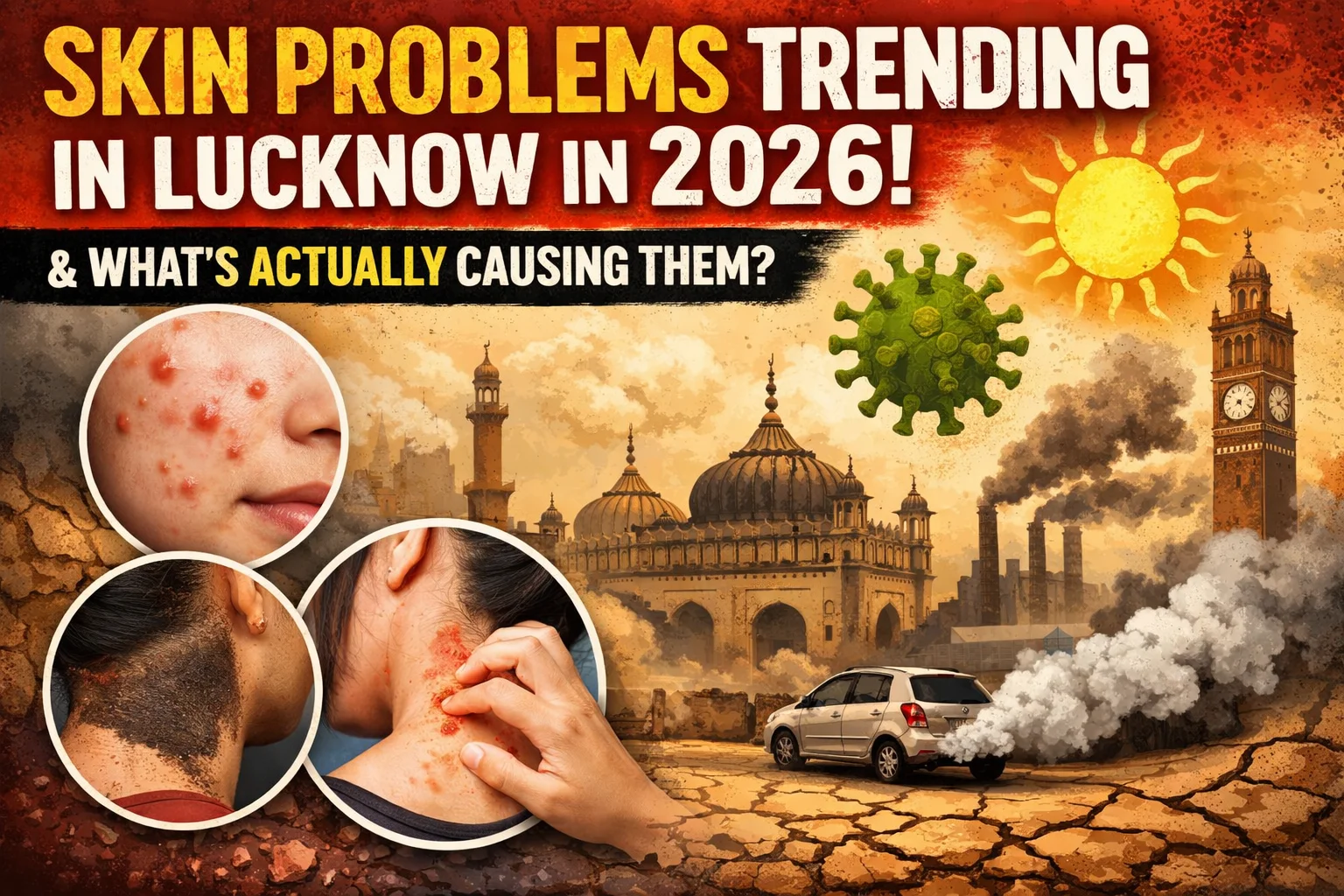
Published on drpragatidermatologist.com | Updated April 2026
If you live in Lucknow, your skin is working overtime.
Between the dust storms rolling in from the Gangetic plains, humidity swings that can shift 40% in a single week, and water quality that varies block by block — your skin is dealing with conditions that no generic skincare routine was built for.
This post breaks down the skin concerns that dermatologists in Lucknow are seeing most in 2026, why they're happening, and what's worth taking seriously.
1. Pollution-Triggered Acne Is Not the Same as Regular Acne
Lucknow's air quality has worsened steadily. The stretch from Alambagh to Hazratganj regularly logs PM2.5 readings that exceed safe limits — especially between October and February.
These fine particles don't just sit on your skin. They penetrate pores, trigger inflammation, and disrupt your skin's natural barrier. The result is a specific pattern of breakouts: small, clustered, and often concentrated around the jawline, forehead, and nose.
This is different from hormonal acne or stress acne. It doesn't respond well to standard over-the-counter treatments. Patients who self-medicate with harsh scrubs or drying agents often end up making the inflammation worse.
What's making this worse in 2026 is the rise of commute culture. More Lucknow residents are spending longer hours on roads — on two-wheelers especially — with direct, prolonged skin exposure to vehicle exhaust and construction dust.
If your breakouts started or worsened in the past year and you haven't changed your diet or routine, air quality may be the trigger worth investigating with a qualified and experienced dermatologist in lucknow.
2. Hard Water Dermatitis — Lucknow's Underdiagnosed Problem
This one doesn't make headlines, but it should.
Lucknow's municipal water supply has notably high mineral content — calcium and magnesium levels that qualify it as hard to very hard water in most tested zones. Areas like Gomti Nagar, Indira Nagar, and parts of Aliganj are particularly affected.
Hard water interferes with your skin in two ways. First, it doesn't rinse soap and cleanser completely — leaving a thin residue that clogs pores over time. Second, it disrupts the skin's pH and strips away natural oils, leading to chronic dryness even in people who don't consider themselves to have dry skin.
The symptoms are easy to misread. Persistent itchiness after bathing. A tight, uncomfortable feeling that doesn't go away even after moisturising. Mild redness around the neck, wrists, and inner elbows. Many patients come in having already cycled through multiple moisturisers with little relief.
The fix isn't just a better cream. It often involves addressing the water itself — shower filters, modified cleansing routines, and barrier-repair treatments prescribed by a dermatologist.
This is one of those conditions that becomes much easier to manage once it's correctly identified.
3. Heat Rashes and Fungal Infections — The Summer Pattern Is Shifting
Lucknow's summers have always been harsh. But the heat now arrives earlier and leaves later.
In 2025, Lucknow recorded temperatures above 40°C as early as late March. In 2026, the pattern is repeating. That extended heat window means the skin conditions that used to be a June-July problem are now starting in April.
Prickly heat, sweat rash, and tinea infections — commonly called ringworm, though it has nothing to do with worms — are all seeing earlier seasonal peaks. Fungal infections in particular thrive in the heat-humidity combination that Lucknow experiences when pre-monsoon humidity builds before the rains arrive.
Areas of the skin that stay moist — underarms, groin, the folds of the neck, between the toes — are the most commonly affected. Synthetic fabrics, tight-fitting clothes, and long sedentary hours (a reality for many office workers and students) make this worse.
A case worth sharing: One of Dr. Pragati's patients — a 34-year-old teacher from Rajajipuram (shared with consent) — came in last May with what she believed was an allergic reaction. She had been applying an antifungal cream purchased from a pharmacy for three weeks with no improvement. On examination, it turned out to be a secondary bacterial infection on top of a fungal one — a combination that required a different treatment approach entirely. She responded well once correctly diagnosed. Her note after treatment: "I kept thinking I was doing the right thing by treating it myself. I didn't realise you could have two things happening at once on the same patch of skin."
This is more common than most people realise. Self-diagnosis with skin conditions — especially during summer — can delay the right treatment and sometimes make the condition more complex.
4. Screen-Related Skin Fatigue and the Lucknow WFH Effect
This is a newer trend, but it's showing up consistently in dermatology consultations across the city.
Lucknow has seen significant growth in its IT and startup ecosystem over the past three years. More residents are working from home or in hybrid setups — spending 8 to 12 hours in front of screens in rooms that often have aggressive air conditioning.
The combination of blue light exposure, recycled indoor air, and inconsistent UV exposure creates a specific kind of skin dullness and barrier disruption. Patients describe it as skin that looks tired, uneven, and congested — even without active breakouts.
This is also contributing to a rise in perioral dermatitis and rosacea-like flushing in younger age groups — conditions that were once more common in people in their 40s and 50s.
The irony is that many of these patients are also consuming a significant amount of skincare content online — and arrive with elaborate multi-step routines that are often doing more harm than good. Over-exfoliation, layering incompatible activities, and chasing trends that weren't designed for Indian skin types are all adding to barrier damage.
A simplified, dermatologist-guided routine almost always outperforms a complicated self-built one.
5. Why Lucknow Residents Need Localised Dermatology Advice
Generic skin advice — from influencers, apps, or even well-meaning family — tends to be built around climates and skin types that don't match Lucknow's reality.
The Fitzpatrick scale types common in Lucknow (typically Type IV and V) respond differently to treatments, have different post-inflammatory hyperpigmentation risks, and need dosing and product formulations calibrated accordingly. What works in a Delhi or Mumbai climate doesn't automatically translate here, given Lucknow's specific humidity curves, water profile, and pollution composition.
This is why a locally grounded dermatologist matters — not just someone who treats skin conditions, but someone who understands the environmental context those conditions are developing in.
What to Do Next
If you're dealing with any of the patterns described above — recurring breakouts, persistent dryness, rashes that aren't improving with OTC treatments, or skin that just looks off despite a consistent routine — it's worth getting a professional assessment.
Self-treatment isn't always wrong. But when it's not working, continuing it rarely helps.
Dr. Pragati Gogia Jain offers consultations specifically calibrated to Lucknow's dermatological environment — from diagnosis to treatment plans that account for local climate, water, and lifestyle factors.
You can book a consultation through the website or call the clinic directly. Early assessment almost always means simpler, faster resolution.
This content is for informational purposes only and does not constitute medical advice. Please consult a qualified dermatologist for diagnosis and treatment.